
Subduction Zone (3D)#
The files are in the directory examples/subduction-3d.
The files and directories for this set of examples includes:
README.md:README file containing a brief description of the various examples.
step*.cfg:PyLith parameter files.
mat_*.cfg:Additional PyLith parameter files that are specific to materials used.
*.cfg:Parameter files in addition to those above that are used with example Python scripts.
*.spatialdb:Spatial database files associated with the spatial databases.
*.py:Python scripts used in the examples.
viz:Directory containing Matplotlib Python scripts for visualizing results.
input:Directory for simulation input data that must be downloaded.
output:Directory containing simulation output. It is created automatically when running the simulations.
Details for specific files#
cas_contours_dep.in.txt.gz:Contours of the top of the slab geometry of the Cascadia subduction zone from Slab1.
cgnss_stations_flat.txt:Coordinates of fake continuous GNSS stations for the CUBIT mesh, which has a flat mesh (top surface z=0).
cgnss_stations_latlon.txt:Latitude and longitude coordinates of fake continuous GNSS stations.
cgnss_stations.txt:Coordinates of fake continuous GNSS stations for the Gmsh mesh, which includes topology and bathymetry; produced by
generate_cgnss.pyusing the output from Step 1.coordsys.py:Utility functions to get coordinate systems used in the examples.
etopo2020_bedrock_local.nc:NetCDF file with local topography and bathymetric from ETopo 2020; used in creating the Gmsh mesh.
fault_slabtop_coseismic.spatialdb:Coseismic slip distribution used in Step 4.
fault_slabtop_creep.spatialdb:Aseismic creep distribution used in Steps 3 and 4.
fault_slabtop_slipweakening.spatialdb:Slip-weakening friction parameters used in Step 5.
fault_slabtop_tractions.spatialdb:Initial fault tractions used in Step 5.
Generated files#
These files are not included in the source and are generated by Python scripts as part of the process of running the examples.
cgnss_synthetic_displacement.txt:Synthetic data for Step 7 inversion generated from the output of Step 6 with added noise; generated by
generate_synthetic_gnssdisp.pyusing the output from Step 6.fault_slabtop_slowslip.spatialdb:Slip distribution used in Step 6; generated by
generate_slowslip.py.fault_slabtop_slowslip.timedb:Time history of slip used in Step 6; generated by
generate_slowslip.py.mat_refstate_grav-*.spatialdb:Reference stress state for Step 8c; generated by
generate_refstate_grav.py.
Overview#
This suite of examples demonstrates use of a wide variety of features and the general workflow often used in research simulations. We base the model on the Cascadia subduction zone (Fig. 143). These examples focus on modeling the deformation associated with the the subducting slab, including interseismic deformation with aseismic slip (creep) and viscoelastic relaxation, coseismic slip on the slab interface and a splay fault, and slow slip events on the subduction interface. We account for the 3D material properties associated with different elastic properties for the subducting slab, mantle, continental crust, and accretionary wedge. To keep the computation time in these examples short, we limit our model to an 800 km \(\times\) 800 km \(\times\) 400 km domain and we use a relatively coarse discretization.
](../../../_images/cascadia.png)
Fig. 143 Cartoon of the Cascadia Subduction Zone showing the subduction of the Juan de Fuca Plate under the North American Plate. Source - U.S. Geological Survey Fact Sheet 060-00#
Fig. 144 shows our conceptual model with a slab, mantle, continental crust, and accretionary wedge. We cut off the slab at a depth of 100 km. We use a transverse geographic projection coordinate system with Portland, Oregon, as the origin to georeference our model. To model the motion of the slab, we include a fault for the subduction interface (the interface between the top of the slab and the mantle, crust, and wedge), as well as a fault between the bottom of the slab and the mantle.
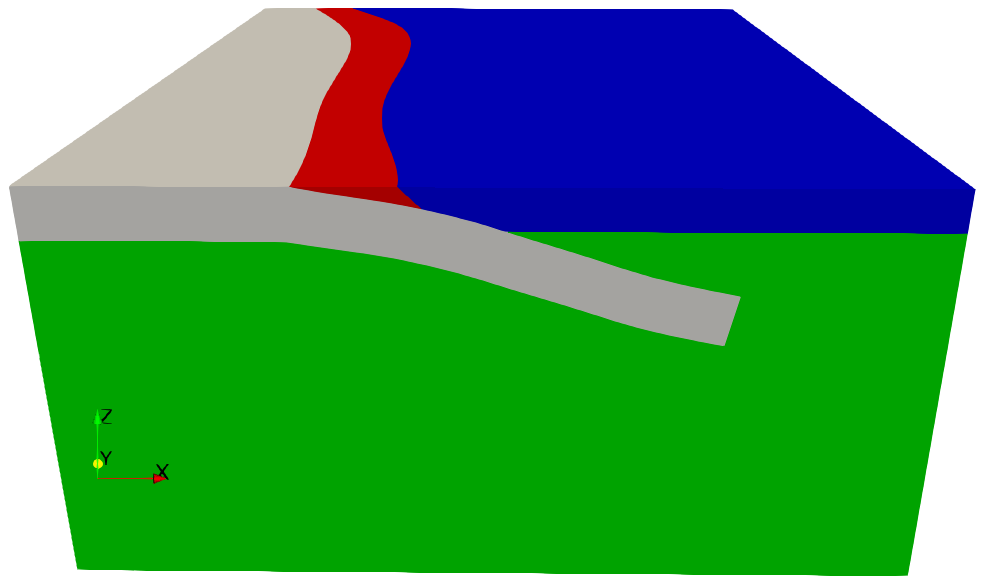
Fig. 144 Conceptual model based on the Cascadia Subduction Zone. The model includes the subduction slab (white), the mantle (green), continental crust (blue), and an accretionary wedge (red).#
- Step 1:
Static axial compression.
- Step 2:
Quasi-static coseismic and postseismic deformation from an earthquake rupture in the center of the subduction zone interface.
- Step 3:
Quasi-static interseisic deformation with creep on the top and bottom of the slab.
- Step 4:
Quasi-static earthquake cycle with prescribed earthquake rupture and creep.
- Step 5:
Spontaneous rupture driven by subducting slab.
- Step 6:
Prescribed slow-slip event.
- Step 7a,b:
Generation of 3D Green’s functions and inversion of displacements for slow slip event from Step 6.
- Step 8a,b,c:
Stress field due to gravitational body forces.
We provide Python scripts for generating finite-element meshes using Gmsh and Cubit and PyLith parameter files for using each of the mesh files.
Warning
Step 5 has not yet been updated for PyLith v3+.
Danger
These simulations are significantly larger than those for the other suites of examples. Some of the time-dependent simulations may take 30 minutes or more to run and use up to 4 GB of memory.
Example Workflow#
- Gmsh Mesh
- Cubit Mesh
- Common Information
- Step 1: Axial Compression
- Step 2: Earthquake Rupture and Postseismic Relaxation
- Step 3: Interseismic Deformation
- Step 4: Earthquake Cycle with Prescribed Slip
- Step 5: Spontaneous Rupture Driven by Subducting Slab
- Step 6: Prescribed Slow Slip Events
- Step 7: Generation of Green’s Functions and Slow Slip Inversion
- Step 8: Use of Gravitational Body Forces
- Suggested Exercises