
Vertical Cross-Section of Subduction Zone (2D)#
The files are in the directory examples/subduction-2d.
The files and directories for this set of examples includes:
README.md:README file containing a brief description of the various examples.
*.cfg:PyLith parameter files.
generate_gmsh.py:Python script to generate mesh using Gmsh.
generate_cubit.py:Python script to generate mesh using Cubit.
*.msh:Gmsh mesh files generated by Gmsh.
*.exo:Exodus II mesh files generated by Cubit.
*.spatialdb:Spatial database filesFiles associated with the spatial databases.
viz:Directory containing Matplotlib Python scripts for visualizing results.
output:Directory containing simulation output. It is created automatically when running the simulations.
Overview#
This example examines quasistatic interseismic and coseismic deformation in 2D for a subduction zone (see Fig. 129). It is based on the 2011 M9.0 Tohoku-oki earthquake off the east coast of Japan. We build on the previous examples and add complexity through a series of steps:
- Step 1:
Static coseismic slip on the subduction interface.
- Step 2:
Quasistatic interseismic deformation with creep on the top and bottom of the slab, except in the zone of coseismic slip.
- Step 3:
Quasistatic earthquake cycle with prescribed coseismic slip and creep.
Warning
Steps 4-6 have not yet been updated for PyLith v3.
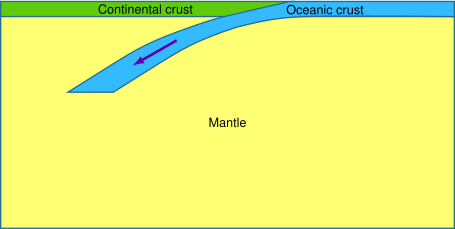
Fig. 129 Diagram of 2D subduction zone example.#
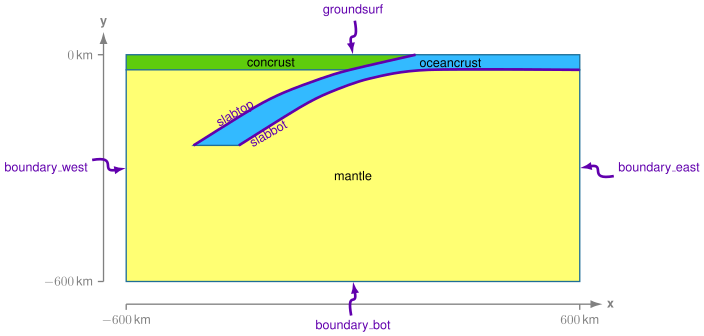
Fig. 130 Geometry of the 2D subduction zone example. The domain extends from -600 km to +600 km in the x direction and from -340 km to 0 in the y direction. We refer to the domain boundaries using the names shown in the diagram.#
Important
We decribe how to generate the finite-element mesh using both Gmsh and Cubit. The files for both methods are included. We use the Gmsh files in the PyLith parameter files. See examples/strikeslip-2d/step01_slip_cubit.cfg for a description of how to modify the parameter files to switch from using mesh files from Gmsh to mesh files from Cubit.