

Step 1: Static Uniform Coseismic Slip#
Features
Triangular cells
pylith.problems.TimeDependent
pylith.materials.Elasticity
pylith.materials.IsotropicLinearElasticity
pylith.faults.FaultCohesiveKin
pylith.faults.KinSrcStep
pylith.bc.DirichletTimeDependent
spatialdata.spatialdb.UniformDB
pylith.meshio.OutputSolnBoundary
pylith.meshio.DataWriterHDF5
Static simulation
pylith.meshio.MeshIOPetsc
Gmsh
Simulation parameters#
This example involves a static simulation that solves for the deformation from prescribed uniform coseismic slip on each of the faults.
Fig. 116 shows the boundary conditions on the domain.
The parameters specific to this example are in step01_slip.cfg.
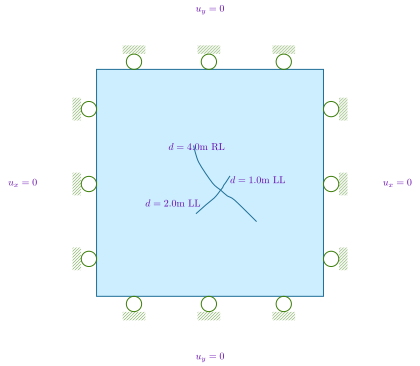
Fig. 116 Boundary conditions for static coseismic slip. On the boundary of the domain, we set the displacement component that is perpendicular to the boundary to zero. We prescribe 4.0 m of right-lateral slip on the main fault, 2.0 m of left-lateral slip on the west branch, and 1.0 m of left-lateral slip on the east branch.#
[pylithapp.problem.interfaces.main_fault.eq_ruptures.rupture]
db_auxiliary_field = spatialdata.spatialdb.UniformDB
db_auxiliary_field.description = Fault rupture auxiliary field spatial database
db_auxiliary_field.values = [initiation_time, final_slip_left_lateral, final_slip_opening]
db_auxiliary_field.data = [0.0*s, -4.0*m, 0.0*m]

[pylithapp.problem.interfaces.west_branch.eq_ruptures.rupture]
db_auxiliary_field = spatialdata.spatialdb.UniformDB
db_auxiliary_field.description = Fault rupture auxiliary field spatial database
db_auxiliary_field.values = [initiation_time, final_slip_left_lateral, final_slip_opening]
db_auxiliary_field.data = [0.0*s, 3.0*m, 0.0*m]

[pylithapp.problem.interfaces.east_branch.eq_ruptures.rupture]
db_auxiliary_field = spatialdata.spatialdb.UniformDB
db_auxiliary_field.description = Fault rupture auxiliary field spatial database
db_auxiliary_field.values = [initiation_time, final_slip_left_lateral, final_slip_opening]
db_auxiliary_field.data = [0.0*s, 1.0*m, 0.0*m]
Running the simulation#
$ pylith step01_slip.cfg

# The output should look something like the following.
 >> /software/unix/py3.12-venv/pylith-debug/lib/python3.12/site-packages/pylith/apps/PyLithApp.py:77:main
 -- pylithapp(info)
 -- Running on 1 process(es).
 >> /software/unix/py3.12-venv/pylith-debug/lib/python3.12/site-packages/pylith/meshio/MeshIOObj.py:38:read
 -- meshiopetsc(info)
 -- Reading finite-element mesh
 >> /src/cig/pylith/libsrc/pylith/meshio/MeshIO.cc:85:void pylith::meshio::MeshIO::read(pylith::topology::Mesh *, const bool)
 -- meshiopetsc(info)
 -- Component 'reader': Domain bounding box:
    (410000, 490000)
    (3.91e+06, 3.99e+06)
 >> /software/unix/py3.12-venv/pylith-debug/lib/python3.12/site-packages/pylith/faults/FaultCohesiveKin.py:87:preinitialize
 -- faultcohesivekin(info)
 -- Pre-initializing fault 'fault_main'.
 >> /software/unix/py3.12-venv/pylith-debug/lib/python3.12/site-packages/pylith/faults/FaultCohesiveKin.py:87:preinitialize
 -- faultcohesivekin(info)
 -- Pre-initializing fault 'fault_west'.
 >> /software/unix/py3.12-venv/pylith-debug/lib/python3.12/site-packages/pylith/faults/FaultCohesiveKin.py:87:preinitialize
 -- faultcohesivekin(info)
 -- Pre-initializing fault 'fault_east'.
 >> /software/unix/py3.12-venv/pylith-debug/lib/python3.12/site-packages/pylith/problems/Problem.py:116:preinitialize
 -- timedependent(info)
 -- Performing minimal initialization before verifying configuration.
 >> /software/unix/py3.12-venv/pylith-debug/lib/python3.12/site-packages/pylith/problems/Solution.py:39:preinitialize
 -- solution(info)
 -- Performing minimal initialization of solution.
 >> /software/unix/py3.12-venv/pylith-debug/lib/python3.12/site-packages/pylith/faults/FaultCohesiveKin.py:87:preinitialize
 -- faultcohesivekin(info)
 -- Pre-initializing fault 'fault_main'.
 >> /software/unix/py3.12-venv/pylith-debug/lib/python3.12/site-packages/pylith/faults/FaultCohesiveKin.py:87:preinitialize
 -- faultcohesivekin(info)
 -- Pre-initializing fault 'fault_west'.
 >> /software/unix/py3.12-venv/pylith-debug/lib/python3.12/site-packages/pylith/faults/FaultCohesiveKin.py:87:preinitialize
 -- faultcohesivekin(info)
 -- Pre-initializing fault 'fault_east'.
 >> /software/unix/py3.12-venv/pylith-debug/lib/python3.12/site-packages/pylith/problems/Problem.py:174:verifyConfiguration
 -- timedependent(info)
 -- Verifying compatibility of problem configuration.
 >> /software/unix/py3.12-venv/pylith-debug/lib/python3.12/site-packages/pylith/problems/Problem.py:219:_printInfo
 -- timedependent(info)
 -- Scales for nondimensionalization:
    Length scale: 1000*m
    Time scale: 3.15576e+09*s
    Pressure scale: 3e+10*m**-1*kg*s**-2
    Density scale: 2.98765e+23*m**-3*kg
    Temperature scale: 1*K
 >> /software/unix/py3.12-venv/pylith-debug/lib/python3.12/site-packages/pylith/problems/Problem.py:185:initialize
 -- timedependent(info)
 -- Initializing timedependent problem with quasistatic formulation.
 >> /src/cig/pylith/libsrc/pylith/utils/PetscOptions.cc:239:static void pylith::utils::_PetscOptions::write(pythia::journal::info_t &, const char *, const PetscOptions &)
 -- petscoptions(info)
 -- Setting PETSc options:
ksp_converged_reason = true
ksp_guess_pod_size = 8
ksp_guess_type = pod
snes_converged_reason = true
snes_monitor = true
ts_error_if_step_fails = true
ts_monitor = true

 >> /src/cig/pylith/libsrc/pylith/utils/PetscOptions.cc:239:static void pylith::utils::_PetscOptions::write(pythia::journal::info_t &, const char *, const PetscOptions &)
 -- petscoptions(info)
 -- Using user values rather then the following default PETSc options:
ksp_atol = 1.0e-12
ksp_error_if_not_converged = true
ksp_rtol = 1.0e-12
snes_atol = 1.0e-9
snes_error_if_not_converged = true
snes_rtol = 1.0e-12

 >> /software/unix/py3.12-venv/pylith-debug/lib/python3.12/site-packages/pylith/problems/TimeDependent.py:132:run
 -- timedependent(info)
 -- Solving problem.
0 TS dt 0.01 time 0.
    0 SNES Function norm 4.696586307427e-02
      Linear solve converged due to CONVERGED_ATOL iterations 19
    1 SNES Function norm 7.572811652012e-13
    Nonlinear solve converged due to CONVERGED_FNORM_ABS iterations 1
1 TS dt 0.01 time 0.01
 >> /software/unix/py3.12-venv/pylith-debug/lib/python3.12/site-packages/pylith/problems/Problem.py:199:finalize
 -- timedependent(info)
 -- Finalizing problem.
At the beginning of the output written to the terminal, we see that PyLith is reading the mesh using the MeshIOPetsc reader and that it found the domain to extend from 410000 to 490000 in the x direction and from 3.91e+06 to 3.99e+06 in the y direction.
The scales for nondimensionalization remain the default values for a quasistatic problem.
PyLith detects the presence of a fault based on the Lagrange multiplier for the fault in the solution field and selects appropriate preconditioning options as discussed in PETSc Options.
At the end of the output written to the terminal, we see that the solver advanced the solution one time step (static simulation).
The linear solve converged after 19 iterations and the norm of the residual met the absolute convergence tolerance (ksp_atol) .
The nonlinear solve converged in 1 iteration, which we expect because this is a linear problem, and the residual met the absolute convergence tolerance (snes_atol).
Earthquake rupture parameters#
We use the pylith_eqinfo utility to compute rupture information, such as earthquake magnitude, seismic moment, seismic potency, and average slip.
For 2D simulations, the average slip provides the most useful information.
pylith_eqinfo is a Pyre application and you specify parameters using cfg files and the command line.
It writes results to a Python script for use in post-processing of simulation results.
The file eqinfoapp.cfg holds the parameters for pylith_eqinfo in this example.
By default, pylith_eqinfo extracts information for the final time step in the output file.
In order to compute the seismic moment and moment magnitude, we need the shear modulus, which in this case is uniform over the domain.
Consquently, we specify the density and shear wave speed using a UniformDB in eqinfoapp.cfg.
$ pylith_eqinfo
output/step01_slip-eqinfo.py generated by pylith_eqinfo. The all object includes earthquake rupture information combined from the three the individual faults. The average slip matches the uniform slip prescribed on each fault.#class RuptureStats(object):
pass
all = RuptureStats()
all.timestamp = [ 3.155760e+07]
all.ruparea = [ 5.387992e+04]
all.potency = [ 1.733080e+05]
all.moment = [ 3.899430e+15]
all.avgslip = [ 3.216560e+00]
all.mommag = [ 4.360667e+00]
main_fault = RuptureStats()
main_fault.timestamp = [ 3.155760e+07]
main_fault.ruparea = [ 3.577375e+04]
main_fault.potency = [ 1.430950e+05]
main_fault.moment = [ 3.219637e+15]
main_fault.avgslip = [ 4.000000e+00]
main_fault.mommag = [ 4.305205e+00]
east_branch = RuptureStats()
east_branch.timestamp = [ 3.155760e+07]
east_branch.ruparea = [ 5.999357e+03]
east_branch.potency = [ 5.999357e+03]
east_branch.moment = [ 1.349855e+14]
east_branch.avgslip = [ 1.000000e+00]
east_branch.mommag = [ 3.386858e+00]
west_branch = RuptureStats()
west_branch.timestamp = [ 3.155760e+07]
west_branch.ruparea = [ 1.210682e+04]
west_branch.potency = [ 2.421364e+04]
west_branch.moment = [ 5.448068e+14]
west_branch.avgslip = [ 2.000000e+00]
west_branch.mommag = [ 3.790828e+00]
Visualizing the results#
The output directory contains the simulation output.
Each “observer” writes its own set of files, so the solution over the domain is in one set of files, the boundary condition information is in another set of files, and the material information is in yet another set of files.
The HDF5 (.h5) files contain the mesh geometry and topology information along with the solution fields.
The Xdmf (.xmf) files contain metadata that allow visualization tools like ParaView to know where to find the information in the HDF5 files.
To visualize the data using ParaView or Visit, load the Xdmf files.
In Fig. 117 we use the pylith_viz utility to visualize the y displacement field.
pylith_viz --filename=output/step01_slip-domain.h5 warp_grid --component=y
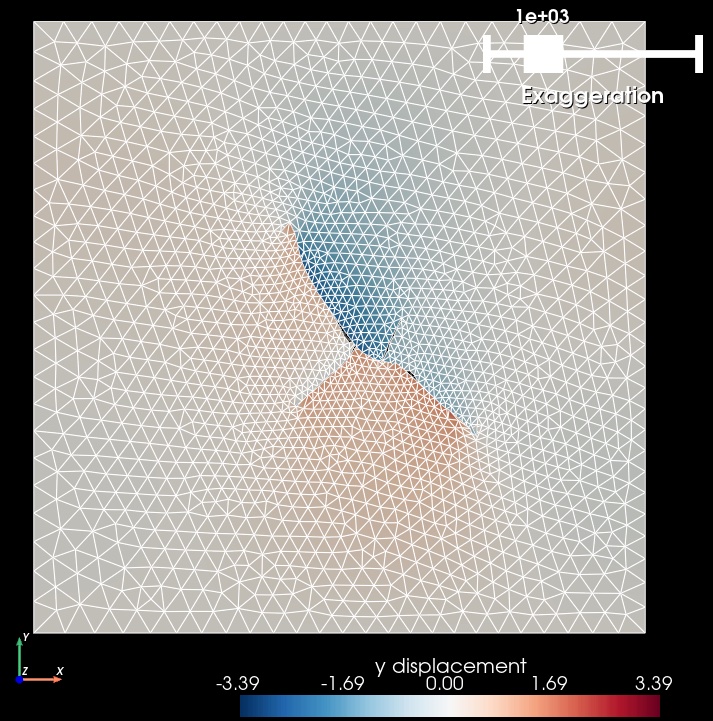
Fig. 117 Solution for Step 1. The colors of the shaded surface indicate the y displacement, and the deformation is exaggerated by a factor of 1000. The undeformed configuration is shown by the gray wireframe. The contrast in material properties across the faults causes the asymmetry in the y displacement field.#
Step 1 with Cubit Mesh#
Using the Cubit mesh rather than the Gmsh mesh involves two changes:
Use the
MeshIOCubitreader instead of theMeshIOPetscreader and change the filename of the mesh file.Set the
label_valueto 1 for boundary conditions and faults.
We must override thelabel_valuesettings inpylithapp.cfgthat were appropriate for our Gmsh reader but are incorrect for the Cubit reader.
The file step01_slip_cubit.cfg provides these changes and updates the names for output.
$ pylith step01_slip_cubit.cfg

# The output should look something like the following.
 >> /software/unix/py3.12-venv/pylith-debug/lib/python3.12/site-packages/pylith/apps/PyLithApp.py:77:main
 -- pylithapp(info)
 -- Running on 1 process(es).
 >> /software/unix/py3.12-venv/pylith-debug/lib/python3.12/site-packages/pylith/meshio/MeshIOObj.py:38:read
 -- meshiocubit(info)
 -- Reading finite-element mesh
 >> /src/cig/pylith/libsrc/pylith/meshio/MeshIOCubit.cc:148:void pylith::meshio::MeshIOCubit::_readVertices(ExodusII &, scalar_array *, int *, int *) const
 -- meshiocubit(info)
 -- Component 'reader': Reading 1610 vertices.
 >> /src/cig/pylith/libsrc/pylith/meshio/MeshIOCubit.cc:208:void pylith::meshio::MeshIOCubit::_readCells(ExodusII &, int_array *, int_array *, int *, int *) const
 -- meshiocubit(info)
 -- Component 'reader': Reading 3125 cells in 1 blocks.
 >> /src/cig/pylith/libsrc/pylith/meshio/MeshIOCubit.cc:270:void pylith::meshio::MeshIOCubit::_readGroups(ExodusII &)
 -- meshiocubit(info)
 -- Component 'reader': Found 10 node sets.
 >> /src/cig/pylith/libsrc/pylith/meshio/MeshIOCubit.cc:296:void pylith::meshio::MeshIOCubit::_readGroups(ExodusII &)
 -- meshiocubit(info)
 -- Component 'reader': Reading node set 'boundary_south' with id 10 containing 25 nodes.
 >> /src/cig/pylith/libsrc/pylith/meshio/MeshIOCubit.cc:296:void pylith::meshio::MeshIOCubit::_readGroups(ExodusII &)
 -- meshiocubit(info)
 -- Component 'reader': Reading node set 'boundary_east' with id 11 containing 25 nodes.
 >> /src/cig/pylith/libsrc/pylith/meshio/MeshIOCubit.cc:296:void pylith::meshio::MeshIOCubit::_readGroups(ExodusII &)
 -- meshiocubit(info)
 -- Component 'reader': Reading node set 'boundary_north' with id 12 containing 24 nodes.
 >> /src/cig/pylith/libsrc/pylith/meshio/MeshIOCubit.cc:296:void pylith::meshio::MeshIOCubit::_readGroups(ExodusII &)
 -- meshiocubit(info)
 -- Component 'reader': Reading node set 'boundary_west' with id 13 containing 23 nodes.
 >> /src/cig/pylith/libsrc/pylith/meshio/MeshIOCubit.cc:296:void pylith::meshio::MeshIOCubit::_readGroups(ExodusII &)
 -- meshiocubit(info)
 -- Component 'reader': Reading node set 'fault_main' with id 20 containing 37 nodes.
 >> /src/cig/pylith/libsrc/pylith/meshio/MeshIOCubit.cc:296:void pylith::meshio::MeshIOCubit::_readGroups(ExodusII &)
 -- meshiocubit(info)
 -- Component 'reader': Reading node set 'fault_west' with id 21 containing 13 nodes.
 >> /src/cig/pylith/libsrc/pylith/meshio/MeshIOCubit.cc:296:void pylith::meshio::MeshIOCubit::_readGroups(ExodusII &)
 -- meshiocubit(info)
 -- Component 'reader': Reading node set 'fault_east' with id 22 containing 6 nodes.
 >> /src/cig/pylith/libsrc/pylith/meshio/MeshIOCubit.cc:296:void pylith::meshio::MeshIOCubit::_readGroups(ExodusII &)
 -- meshiocubit(info)
 -- Component 'reader': Reading node set 'fault_main_ends' with id 30 containing 2 nodes.
 >> /src/cig/pylith/libsrc/pylith/meshio/MeshIOCubit.cc:296:void pylith::meshio::MeshIOCubit::_readGroups(ExodusII &)
 -- meshiocubit(info)
 -- Component 'reader': Reading node set 'fault_west_ends' with id 31 containing 2 nodes.
 >> /src/cig/pylith/libsrc/pylith/meshio/MeshIOCubit.cc:296:void pylith::meshio::MeshIOCubit::_readGroups(ExodusII &)
 -- meshiocubit(info)
 -- Component 'reader': Reading node set 'fault_east_ends' with id 32 containing 2 nodes.
 >> /src/cig/pylith/libsrc/pylith/meshio/MeshIO.cc:85:void pylith::meshio::MeshIO::read(pylith::topology::Mesh *, const bool)
 -- meshiocubit(info)
 -- Component 'reader': Domain bounding box:
    (410000, 490000)
    (3.91e+06, 3.99e+06)

-- many lines omitted --

 >> /software/unix/py3.12-venv/pylith-debug/lib/python3.12/site-packages/pylith/problems/TimeDependent.py:132:run
 -- timedependent(info)
 -- Solving problem.
0 TS dt 0.01 time 0.
    0 SNES Function norm 2.540894009864e-02
      Linear solve converged due to CONVERGED_ATOL iterations 45
    1 SNES Function norm 1.131725395538e-12
    Nonlinear solve converged due to CONVERGED_FNORM_ABS iterations 1
1 TS dt 0.01 time 0.01
 >> /software/unix/py3.12-venv/pylith-debug/lib/python3.12/site-packages/pylith/problems/Problem.py:199:finalize
 -- timedependent(info)
 -- Finalizing problem.
The MeshIOCubit reader includes diagnostic information in the journal output related to the sizes of the nodesets and material blocks.