

2D Outer-Rise Hydration Using Poroelasticity#
The files are in the directory examples/poroelastic-outerrise-2d.
The files and directories for this set of examples includes:
README.md:README file containing a brief description of the various examples.
*.cfg:PyLith parameter files.
generate_gmsh.py:Python script to generate mesh using Gmsh.
*.msh:Gmsh mesh files generated by Gmsh.
*.spatialdb:Spatial database filesFiles associated with the spatial databases.
output:Directory containing simulation output. It is created automatically when running the simulations.
Overview#
This example examines how bending stresses and permeability structure influence the hydration state of a slab of oceanic lithosphere in the outer-rise of a subduction zone. The poroelastic slab is deformed based on bathymetry along a trench-orthogonal transect of the Central-American subduction system. Enhanced permeability is introduced in the outer-rise to simulate the effect of normal faulting.
- Step 1:
Underformed lithosphere with a uniform fluid-pressure applied to the top-boundary
- Step 2:
Lithosphere is deformed to the current bathymetry over 0.3 Myr.
- Step 3:
Lithosphere is deformed to the current bathymetry over 0.3 Myr with enhanced permeability from outer-rise faults.
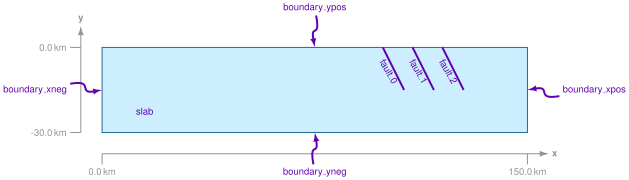
Fig. 166 Diagram of geometry used for poroelastic-outerrise-2d. The domain extends from 0 km to +150 km in the x direction and from -30 km to 0 km in the y direction. We refer to the domain boundaries using the names shown in the diagram.#