

Intersecting Strike-Slip Faults (3D)#
Note
New in v4.1.0
The files are in the directory examples/crustal-strikeslip-3d.
The files and directories for this set of examples includes:
README.md:README file containing a brief description of the various examples.
*.cfg:PyLith parameter files.
faulttrace*_latlon.txt:Coordinates of points on fault traces in geographic coordinates.
faulttrace*_utm.txt:Coordinates of points on fault traces in the UTM zone 11 projection.
generate_gmsh.py:Python script to generate the finite-element mesh using Gmsh.
generate_cubit.py:Python script to generate the finite-element mesh using Cubit.
*.msh:Gmsh finite-element mesh files generated by Gmsh.
*.spatialdb:Spatial database filesFiles associated with the spatial databases.
output:Directory containing simulation output. It is created automatically when running the simulations.
Overview#
This suite of examples demonstrates using PyLith to model multiple intersecting faults embedded in a 3D georeferenced domain (Fig. 118). The geometry is based on studies of the 2019 Ridgecrest earthquake sequence by Uphoff et al. [2022] and Nevitt et al. [2023].
- Step 1:
Static uniform coseismic slip with Dirichlet (displacement) boundary conditions.
- Step 2:
Static spatially varying coseismic slip with Dirichlet (displacement) boundary conditions.
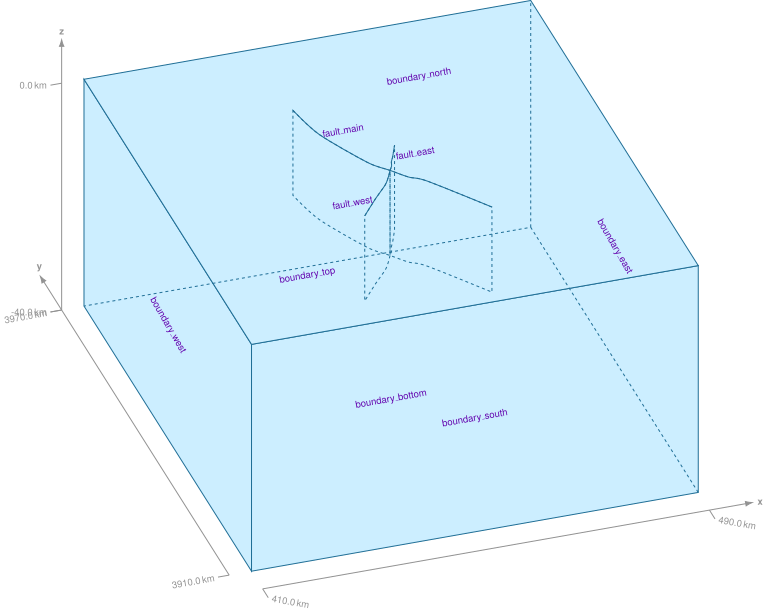
Fig. 118 Diagram of geometry for the domain with three intersecting strike-slip faults. The domain extends from 80 km in the east-west direction, 60 km in the north-south direction, and 40 km in the vertical direction. We refer to the domain boundaries using the names shown in the diagram.#
Important
We describe how to generate the finite-element mesh using both Gmsh and Cubit. For Step 1 we provide PyLith parameter files for both meshes; for Step 2 we only provide the parameter files that use the Gmsh file.