Vertical Cross-Section of a Reverse Fault with Splay (2D)#
The files are in the directory examples/reverse-2d.
The files and directories for this set of examples includes:
README.mdREADME file containing a brief description of the various examples.
*.cfgPyLith parameter files.
generate_gmsh.pyPython script to generate mesh using Gmsh.
*.mshGmsh mesh files generated by Gmsh.
*.jouFiles used to construct the finite-element mesh using CUBIT/Trelis.
*.exoExodus II mesh files generated by Cubit.
*.spatialdbSpatial database filesFiles associated with the spatial databases.
vizDirectory containing ParaView Python scripts and other files for visualizing results.
outputDirectory containing simulation output. It is created automatically when running the simulations.
Overview#
This suite of examples demonstrates use of a number of features for a vertical cross section of a reverse fault accompanied by a splay fault (Fig. 67) with elastic and viscoelastic material properties. We separately consider loading from gravitational body forces, surface tractions, and coseismic slip. We build on the previous examples and add complexity through a series of steps:
- Step 1
Gravitational body forces and linear isotropic elasticity.
- Step 2
Gravitational body forces and linear isotropic elasticity with a reference stress state.
- Step 3
Gravitational body forces and linear isotropic incompressible elasticity.
- Step 4
Surface tractions and linear isotropic linear elasticity.
- Step 5
Earthquake rupture on one fault and linear isotropic linear elasticity.
- Step 6
Earthquake rupture on two faults and linear isotropic linear elasticity.
- Step 7
Earthquake rupture on two faults and linear isotropic Maxwell viscoelastic rheology.
- Step 8
Earthquake rupture on two faults and linear isotropic powerlaw viscoelastic rheology.
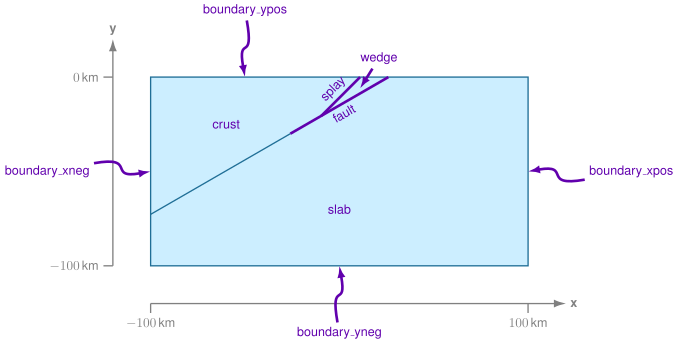
Fig. 67 Diagram of geometry for domain with reverse and splay faults and three materials (crust, slab, and wedge). The domain extends from -100 km to +100 km in the x direction and from -100 km to 0 in the y direction. We refer to the domain boundaries using the names shown in the diagram.#
Important
We decribe how to generate the finite-element mesh using both Gmsh and Cubit. The files for both methods are included. We use the Gmsh files in the PyLith parameter files. See examples/strikeslip-2d/step01_slip_cubit.cfg for a description of how to modify the parameter files to switch from using mesh files from Gmsh to mesh files from Cubit.
Example Workflow#
- Gmsh Mesh
- Cubit Mesh
- Common Information
- Step 1: Gravitational Body Forces
- Step 2: Gravitational Body Forces with Reference Stress
- Step 3: Gravitational Body Forces with Incompressible Elasticity
- Step 4: Surface Tractions
- Step 5: Static Coseismic Slip
- Step 6: Slip on Two Faults and Elastic Materials
- Step 7: Slip on Two Faults and Maxwell Viscoelastic Materials
- Step 8: Slip on Two Faults and Power-law Viscoelastic Materials
- Suggested Exercises