

Step 2: Single Earthquake Rupture and Velocity Boundary Conditions#
Features
Triangular cells
pylith.meshio.MeshIOPetsc
pylith.problems.TimeDependent
pylith.materials.Elasticity
pylith.materials.IsotropicLinearElasticity
pylith.faults.FaultCohesiveKin
pylith.faults.KinSrcStep
field split preconditioner
Schur complement preconditioner
pylith.bc.DirichletTimeDependent
spatialdata.spatialdb.UniformDB
pylith.meshio.OutputSolnBoundary
pylith.meshio.DataWriterHDF5
Quasi-static simulation
spatialdata.spatialdb.SimpleDB
Simulation parameters#
This example involves a quasi-static simulation that solves for the deformation from velocity boundary conditions and prescribed coseismic slip on the fault.
We let strain accumulate due to the motion of the boundaries and then release the strain by prescribing 2 meters of right-lateral slip at t=100 years.
Fig. 62 shows the boundary conditions on the domain.
The parameters specific to this example are in step02_slip_velbc.cfg.
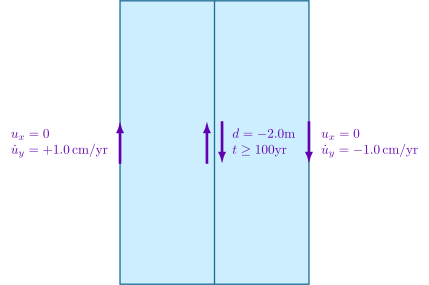
Fig. 62 Boundary conditions for quasistatic simulation with velocity boundary conditions and coseismic slip. We set the x displacement to zero on the +x and -x boundaries. We set the y velocity to -1 cm/yr on the +x boundary and +1 cm/yr on the -x boundary. We prescribe 2 meters of right-lateral slip to occur at 100 years to release the accumulated strain energy.#
[pylithapp.problem]
initial_dt = 5.0*year
start_time = -5.0*year
end_time = 120.0*year
Boundary conditions#
We switch the Dirichlet boundary conditions from specifying an initial amplitude to specifying a constant velocity,
[pylithapp.problem.bc.bc_xpos]
use_initial = False
use_rate = True

db_auxiliary_field = spatialdata.spatialdb.SimpleDB
db_auxiliary_field.description = Dirichlet BC +x boundary
db_auxiliary_field.iohandler.filename = disprate_bc_xpos.spatialdb
As in Step 1 we prescribe 2.0 meters of right-lateral slip, but in this case we set slip to occur at t=100 years.
[pylithapp.problem.interfaces.fault.eq_ruptures.rupture]
db_auxiliary_field = spatialdata.spatialdb.UniformDB
db_auxiliary_field.description = Fault rupture auxiliary field spatial database
db_auxiliary_field.values = [initiation_time, final_slip_left_lateral, final_slip_opening]
db_auxiliary_field.data = [100.0*year, -2.0*m, 0.0*m]
Running the simulation#
$ pylith step02_slip_velbc.cfg

# The output should look something like the following.
>> software/pylith-debug/lib/python3.12/site-packages/pylith/apps/PyLithApp.py:79:main
-- info (application-flow)
-- Running on 1 process(es).

# -- many lines omitted --
>> src/cig/pylith/libsrc/pylith/problems/TimeDependent.cc:473:void pylith::problems::TimeDependent::solve()
-- info (application-flow)
-- Component 'timedependent.problem': Solving equations.
0 TS dt 0.05 time -0.05
    0 SNES Function norm 0.000000000000e+00
    Nonlinear solve converged due to CONVERGED_FNORM_ABS iterations 0
1 TS dt 0.05 time 0.
    0 SNES Function norm 1.587863174294e+00
      Linear solve converged due to CONVERGED_ATOL iterations 9
    1 SNES Function norm 4.122054854127e-08
    Nonlinear solve converged due to CONVERGED_FNORM_ABS iterations 1

# -- many lines omitted --

24 TS dt 0.05 time 1.15
    0 SNES Function norm 1.587863188128e+00
      Linear solve converged due to CONVERGED_ATOL iterations 1
    1 SNES Function norm 4.146299281838e-08
    Nonlinear solve converged due to CONVERGED_FNORM_ABS iterations 1
25 TS dt 0.05 time 1.2
>> software/pylith-debug/lib/python3.12/site-packages/pylith/problems/Problem.py:222:finalize
-- info (application-flow)
-- Finalizing problem.
The beginning of the output written to the terminal is identical to that from Step 1. At the end of the output, we see that the simulation advanced the solution 25 time steps. Remember that the PETSc TS monitor shows the nondimensionalized time and time step values.
Visualizing the results#
In Fig. 63 we use the pylith_viz utility to visualize the y displacement field.
You can move the slider or use the p and n keys to change the increment or decrement time.
pylith_viz --filename=output/step02_slip_velbc-domain.h5 warp_grid --component=y

Fig. 63 Solution for Step 2 at t=100 yr. The colors of the shaded surface indicate the y displacement, and the deformation is exaggerated by a factor of 1000. The undeformed configuration is shown by the gray wireframe. The coseismic fault slip at 100 years releases all of the accumulated strain energy.#