

Axial and Shear Deformation (3D Box)#
This example is the 3D version of the 2D box axial shear and deformation example (examples/box-2d).
The files are in the directory examples/box-3d and include:
README.md:README file containing a brief description of the various examples.
*.cfg:PyLith parameter files.
generate_gmsh.py:Python script to generate the finite-element mesh using Gmsh.
generate_cubit.py:Python script to generate the finite-element mesh using Cubit.
*.msh:Gmsh finite-element mesh files generated by Gmsh.
*.exo:Exodus II finite-element mesh files generated by Cubit.
*.spatialdb:Spatial database filesFiles associated with the spatial databases.
output:Directory containing simulation output. It is created automatically when running the simulations.
Overview#
This suite of examples demonstrates some basic concepts of using PyLith to solve the static and quasistatic boundary elasticity equation in a 3D box (Fig. 36) with uniform material properties. The examples incrementally add complexity through a series of steps:
- Step 1:
Axial extension with Dirichlet (displacement) boundary conditions.
- Step 2:
Shear deformation with Dirichlet (displacement) boundary conditions.
- Step 3:
Shear deformation with Dirichlet (displacement) and Neumann (traction) boundary conditions.
- Step 4:
Same as Step 2 but with initial conditions equal to the analytical solution.
- Step 5:
Shear deformation with time-dependent Dirichlet (displacement) and Neumann (traction) boundary conditions.
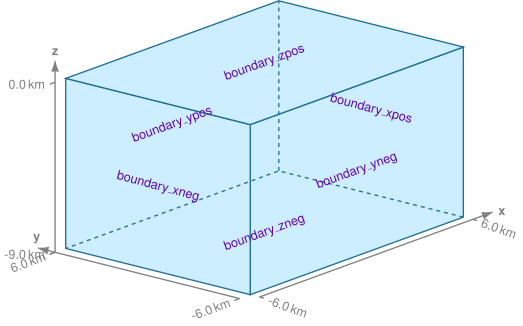
Fig. 36 Diagram of geometry for 3D box that extends from -6 km to +6 km in the x and y directions and from -9 km to 0 km in the z direction. We refer to the domain boundaries using the names shown in the diagram.#