
Axial and Shear Deformation (3D Box)#
This example is the 3D version of the 2D box axial shear and deformation example (examples/box-2d).
The files are in the directory examples/box-3d and include:
README.mdREADME file containing a brief description of the various examples.
*.cfgPyLith parameter files.
generate_gmsh.pyPython script to generate the finite-element mesh using Gmsh.
*.mshGmsh finite-element mesh files generated by Gmsh.
*.jouFiles used to construct the finite-element mesh using Cubit.
*.exoExodus II finite-element mesh files generated by Cubit.
*.spatialdbSpatial database filesFiles associated with the spatial databases.
vizDirectory containing ParaView Python scripts and other files for visualizing results.
outputDirectory containing simulation output. It is created automatically when running the simulations.
Overview#
This suite of examples demonstrates some basic concepts of using PyLith to solve the static and quasistatic boundary elasticity equation in a 3D box (Fig. 35) with uniform material properties. The examples incrementally add complexity through a series of steps:
- Step 1
Axial extension with Dirichlet (displacement) boundary conditions.
- Step 2
Shear deformation with Dirichlet (displacement) boundary conditions.
- Step 3
Shear deformation with Dirichlet (displacement) and Neumann (traction) boundary conditions.
- Step 4
Same as Step 2 but with initial conditions equal to the analytical solution.
- Step 5
Shear deformation with time-dependent Dirichlet (displacement) and Neumann (traction) boundary conditions.
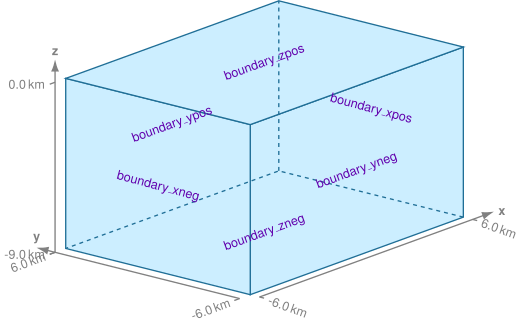
Fig. 35 Diagram of geometry for 3D box that extends from -6 km to +6 km in the x and y directions and from -9 km to 0 km in the z direction. We refer to the domain boundaries using the names shown in the diagram.#