

3-D Linear Elasticity with Prescribed Slip#
We evaluate solver performance for 3-D plane strain linear elasticity with prescribed slip using Step 2 (variable slip) from examples/crustal-strikeslip-3d.
We create a suite of simulations in which we generate meshes with factors of 2 reduction in cell size on the fault.
We assess the performance based on the number of iterations in the linear solver, the time required to solve, and the total runtime.
Important
Generating high quality meshes with tetrahedral cells is much more difficult than it is in 2-D for triangular cells. In this benchmark, we found degradation of mesh quality with uniform global refinement, which resulted in a substantial increase in the number of iterations required by the linear solver. Generating meshes for each discretization size on the fault provided an alternative approach. Furthermore, generating meshes for each discretization size maintains the geometric rate of increase in cell size with distance from the faults. In this case the number of unknowns increases by about a factor of 4 each each factor of 2 reduction in the cell size on the fault; this is a factor of 2 smaller than that for uniform global refinement.
Running the Benchmark#
# Generate the finite-element meshes using Gmsh
./generate_gmsh.py --write --level=0 --filename=mesh_tet2500.msh
./generate_gmsh.py --write --level=1 --filename=mesh_tet1250.msh
./generate_gmsh.py --write --level=2 --filename=mesh_tet0625.msh
./generate_gmsh.py --write --level=3 --filename=mesh_tet0312.msh
./generate_gmsh.py --write --level=4 --filename=mesh_tet0156.msh
./generate_gmsh.py --write --level=5 --filename=mesh_tet0078.msh

# Run the benchmark simulations
pylith step02_fieldsplit_selfp.cfg >& logs/step02a_fieldsplit_selfp.stdout
pylith step02_fieldsplit_selfp.cfg step02b_fieldsplit_selfp.cfg >& logs/step02b_fieldsplit_selfp.stdout

pylith step03_vpbjacobi.cfg >& step03a_vpbjacobi.stdout
pylith step03_vpbjacobi.cfg step03b_vpbjacobi.cfg >& step03b_vpbjacobi.stdout
pylith step03_vpbjacobi.cfg step03c_vpbjacobi.cfg >& step03c_vpbjacobi.stdout
pylith step03_vpbjacobi.cfg step03d_vpbjacobi.cfg >& step03d_vpbjacobi.stdout

pylith step04_vpbjacobi_tunefine.cfg >& step04a_vpbjacobi_tunefine.stdout
pylith step04_vpbjacobi_tunefine.cfg step04b_vpbjacobi_tunefine.cfg >& step04b_vpbjacobi_tunefine.stdout
pylith step04_vpbjacobi_tunefine.cfg step04c_vpbjacobi_tunefine.cfg >& step04c_vpbjacobi_tunefine.stdout
pylith step04_vpbjacobi_tunefine.cfg step04d_vpbjacobi_tunefine.cfg >& step04d_vpbjacobi_tunefine.stdout
pylith step04_vpbjacobi_tunefine.cfg step04e_vpbjacobi_tunefine.cfg >& step04e_vpbjacobi_tunefine.stdout
pylith step04_vpbjacobi_tunefine.cfg step04f_vpbjacobi_tunefine.cfg >& step04f_vpbjacobi_tunefine.stdout

pylith step06_vpbjacobi_dispscale.cfg >& step06a_vpbjacobi_dispscale.stdout
pylith step06_vpbjacobi_dispscale.cfg step06b_vpbjacobi_dispscale.cfg >& step06b_vpbjacobi_dispscale.stdout
pylith step06_vpbjacobi_dispscale.cfg step06c_vpbjacobi_dispscale.cfg >& step06c_vpbjacobi_dispscale.stdout
pylith step06_vpbjacobi_dispscale.cfg step06d_vpbjacobi_dispscale.cfg >& step06d_vpbjacobi_dispscale.stdout
pylith step06_vpbjacobi_dispscale.cfg step06e_vpbjacobi_dispscale.cfg >& step06e_vpbjacobi_dispscale.stdout
pylith step06_vpbjacobi_dispscale.cfg step06f_vpbjacobi_dispscale.cfg >& step06f_vpbjacobi_dispscale.stdout
Results#
For small problems (about 10,000) unknowns we find little difference in the runtimes across the different solver settings. As the number of unknowns increases towards 100,000, the number of iterations required by the Schur complement field split preconditioner increases dramatically, resulting in dramatic increases in runtime. The geometric algegraic multigrid preconditioner with variable point block Jacobi preconditioner at the fine scale with default parameters works well up to about 100,000 unknowns. Fine-tuning the fine-scale multigrid preconditioner parameters gives good performance across the entire range of problem sizes considered.
Note
Using independent displacement amd length scales does not improve solver performance, but it allows use of solver tolerances that are relative to the displacement scale and independent of discretization size.
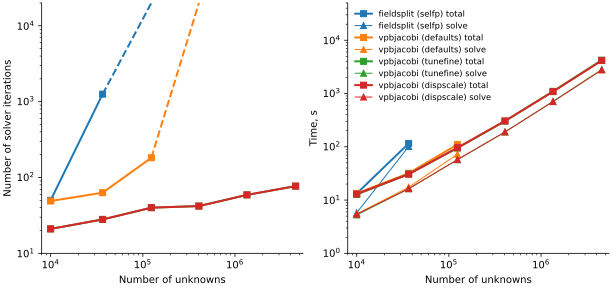
Fig. 184 Solver performance for 3-D elasticity with prescribed slip. The left panel shows the number of iterations used by the linear solver as a function of the problem size (number of unknowns). The right panels shows the total (squares) and solve (triangles) runtime as a function of hte problem size (number of unknowns). The dashed lines indicate the solves required more than 10,000 iterations at the next level of refinement.#